
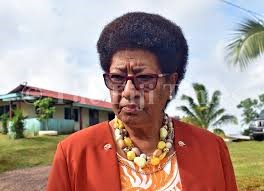
THERE are too many issues related to truth and reconciliation in the country that the Government simply cannot solve on its own. In an interview yesterday, Rewa high chief Ro Teimumu Kepa highlighted the importance of Fiji’s traditional three-legged stool – the Matanitu (government), the lotu (church), and the vanua (village and chiefly system).
Ro Teimumu argued that these three pillars must work together to effectively address the trauma and reconciliation and healing needed in the country.
She pointed out that some of the issues tied to reconciliation stretched back as far as 37 to 38 years, and while the government has made strides through the Truth and Reconciliation Commission (TRC) and other initiatives, it was not enough.
She expressed gratitude for the collaborative efforts of groups like the TRC, which have facilitated workshops such as “the Trauma Awareness and Recovery Workshop for women leaders”.
However, she made it clear that the involvement of the church and village systems was essential for a holistic reconciliation process.
“The TRC is a big, big umbrella, and we all come under it.
In response, TRC chairwoman Sashi Kiran acknowledged the role of traditional institutions involved in the process.
She pointed out that earlier this year, the TRC consulted with the Great Council of Chiefs (GCC), and chairman Ratu Viliame Seruvakula had expressed support for the commission’s work.
However, Ms Kiran explained that although the GCC’s support was crucial, the process of engaging with the vanua was still in its early stages.
“At this stage, we are inviting organisations to start speaking about trauma awareness, and we are there to help,” Ms Kiran said.
“We’ve reached out to faith-based organisations, women’s groups, youth organisations, and the media to begin this conversation. We are about to visit village communities to continue the awareness.”
While the TRC’s efforts are ongoing, Ms Kiran acknowledged that establishing a fully functional commission to work with the vanua will take time.

