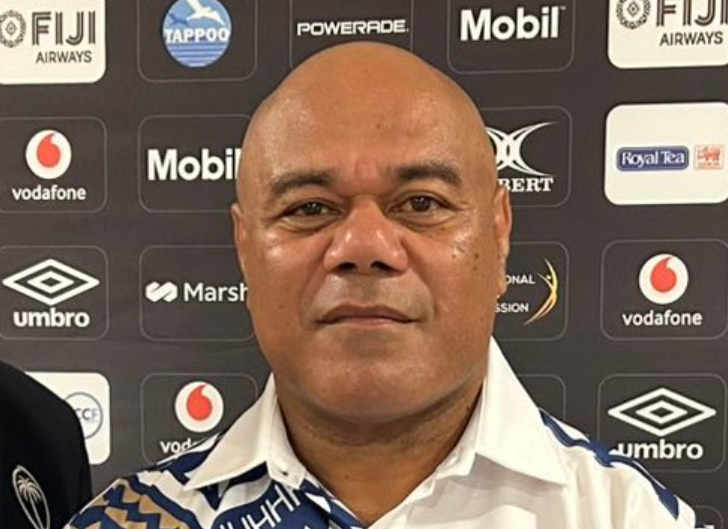
IT’S tempting to judge acting national rugby coach Senirusi Seruvakula by the heights he reached as a player. But that would mean most people would definitely miss what makes him worth watching right now as a coach.
The Naitasiri man does not have the decorated international playing career many expect of a national coach.
In a rugby-mad nation such as Fiji, that alone can shape perceptions, fairly or not.
Seruvakula is someone I would call a coach with the midas touch.
He made only one international appearance for Fiji in 2002 against Samoa. Instead, he was grinding it out in club rugby in Australia and for Naitasiri on our local scene.
He follows, if one would allow, in the footsteps of one great coach – Sir Graham Henry, the Rugby World Cup winning coach for the New Zealand All Blacks. Graham, it must be pointed out, only represented Canterbury in rugby and Canterbury and Otago in cricket for the Plunket Shield. He was a former schoolteacher, in fact he was a headmaster, whom the rugby world would eventually know as one who has the magic touch.
Top 7s coaches Gordon Tietjens, Ben Ryan, Gareth Baber and Damian McGrath, all these were great coaches with little colour, when compared with some of their player peers. South Africa had Paul Treu, Simon Amour of England, Tomasi Cama of New Zealand to name a few who all struggled to click when it came to coaching.
Then there is the maestro, Waisale Serevi, former Australia 7s coach Michael O’Connor, and Mike Friday who are all great in their playing and coaching days.
There’s often an assumption that only elite former players can command respect at the top level. What is forgotten, sometimes quite conveniently, that coaching is entirely a different craft.
What Seruvakula has shown through his coaching career, he influenced the Fijian Drua and Fijian Latui, Fijiana XV, Fijiana Drua in the Super W, is an ability to build systems, nurture belief, and get the best out of players.
These are coaching traits, not playing accolades.
Let’s put that aside and focus on Seruvakula’s upcoming stretch against Wales, England, and Scotland – being framed as a “Test”. The real question is, a test of what?
His resume already shows he can build winning environments. What he hasn’t yet had is sustained backing at the highest level, something he himself has hinted was missing under past Fiji Rugby leadership.
The idea that he must “prove himself” again feels slightly misplaced. It’s really tough to argue that giving him just three matches to prove his worth is anything close to fair.
Coaches such as him don’t rely on past glory; he create future success.
His strength lies in connection, with players, with culture, with the vanua, and that’s something statistics alone doesn’t capture.
He may not have been a star on the field, but he understands the modern player, commands respect and has shown he can shape teams into genuine contenders.
If given time and trust, his legacy may end up being far greater on the sidelines than it ever could have been in a jersey.
Someone such as Seruvakula falls in the category of a “gardener who plants the trees, knowing he will never sit in the shade they will provide”. Under the old system of FRU, plainly, he was the fall-back guy.
Venting his frustration at an event, Seruvakula was quoted as saying: “Sometimes, I feel I have been used, I groom players and someone else just comes and takes the reward.”
Anybody can coach a talented athlete, but few can develop it. After being in the media industry for over two decades, I have found that he is a good coach who doesn’t ask for the spotlight; he empower his players to shine in it. He possesses the greatest acts of coaching when no one is watching him.
Forget about the pay, there at one point came the biggest controversy. The initial appointment of Byrne over Seruvakula in early 2024 caused significant debate.
Local rugby bodies such as Suva and Naitasiri advocated for local representation and expressing frustration over the selection process.
After a series of consideration, I came to my senses that coaching at international level is not a short-term audition, it’s a long-term project with systems, combinations, confidence, and culture will not just fall into place over the span of three games against heavyweights like Wales, England, and Scotland.
And at the upcoming Rugby Nations Cup, we will be up against Tier 1 nations with depth, structure, and years of continuity. For Seruvakula to perform and perform well, it is a tough task from the bosses at Valekau and the rugby public.
For a right-thinking individual to be judging Seruvakula solely on results from such a narrow window ignores the broader realities of international rugby.
What makes the situation more questionable is the comparison with past appointments under the Fiji Rugby Union. Previous coaches have been afforded longer tenures despite inconsistent, or at times underwhelming, results.
Seruvakula, by contrast, carries a track record of building competitive sides and achieving wins, including his influence in the Flying Fijians first-ever victory over France on November 24, 2018, in Paris, winning 21–14 at the Stade de France. If anything, that suggests he deserves more time, not less.
With Fiji set to face Ireland, France, and Italy in the 2026 Nations Championship, the question should not be why give Seruvakula another chance, but why not?
He already knows the core group of players, understands the style of rugby, and has worked within the system for years.
Continuity matters in modern rugby, especially against tier one opposition.
What Fiji rugby needs heading into 2026 is stability, not another coaching test.
If the player pool remains largely unchanged, then changing coaches repeatedly solves very little.
The focus should instead be on giving a coach enough time to implement systems giving Seruvakula another opportunity would not be a gamble.
It would be an investment in consistency ahead of one of Fiji’s biggest rugby challenges.
There’s also a deeper issue at play – what exactly is being evaluated? If it’s immediate wins, then the expectations are unrealistic.
If it’s progress—improved structure, discipline, and cohesion, then three games are barely enough to scratch the surface.
Coaches need trust and continuity, not pressure deadlines that encourage short-term thinking.
This feels less like a genuine opportunity and more like a test designed with a narrow margin for success.
And that raises concerns about consistency and fairness in how coaching appointments are handled, in this case, for Seruvakula.
If the goal is to build a stronger team, then the approach should reflect patience and long-term vision, not a three-game ultimatum.
In the end, the question isn’t just whether Seruvakula can prove himself. It’s whether the system around him is willing to give him a real chance to succeed.
AT A GLANCE