
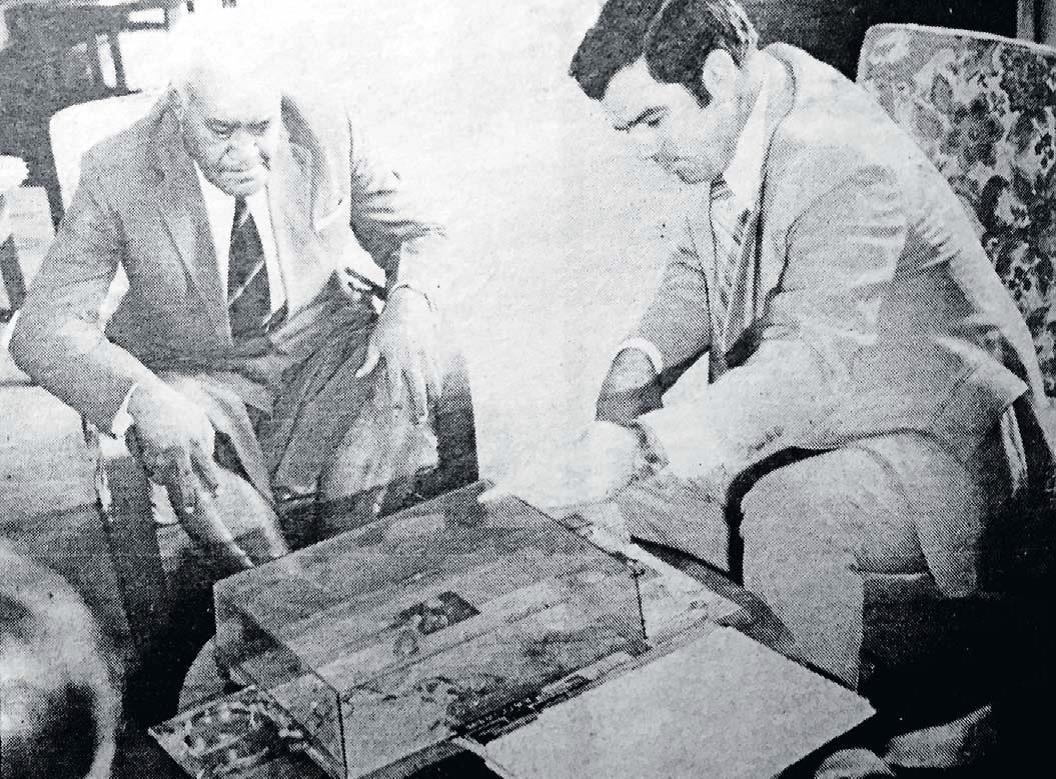
In 1965, part of the American Gemini space capsule which passed over Fiji was presented to the then Governor-General, Ratu Sir George Cakobau.
The renowned American Gemini 3 according to the National Aeronautics and Space Administration (NASA) was the first crewed Earth-orbiting of the Gemini series.
According to NASA, it was piloted by astronauts Virgil “Gus” Grissom and John Young with the primary objective of demonstrating the crewed qualifications of the Gemini spacecraft including evaluation of the two-man Gemini design, the worldwide tracking network, the Orbit Attitude and Maneuver System (OAMS), the control of reentry flight path and landing point, spacecraft systems and spacecraft recovery.
The Fiji Times reported on November 29, 1978 the handover of the small ball titanium between the Rev Carl Baugh of the Calvary Heights Baptist Temple in Missouri and the Governor-General.
This newspaper described that the lightweight metal ball was presented to the Governor-General in a presentation case.
Mr Baugh told The Fiji Times that he was making the presentation because of what he called the historical relationship between Fiji and the United States.
The particular ball that was presented to Fiji according to this newspaper was one of those aboard a Gemini 3 space capsule which orbited the Earth three times on March 23, 1965, carrying the two astronauts.
This newspaper highlighted that Commander Grissom later died during the launching of an Apollo spacecraft in 1967.
Mr Baugh said the ball was presented to the Calvary Heights Baptist Temple some years ago because of the temple’s concern in preventing the loss of human life in the space program.
Mr Baugh was in Fiji with his son Samuel when he handed over the metal ball.
On spacecraft and subsystem details of the Gemini spacecraft, according to NASA it was a cone-shaped capsule consisting of two components, a reentry module and an adaptor module.
The adaptor module made up the base of the spacecraft and it was a truncated cone 228.6cm high, 304.8cm in diameter at the base and 228.6cm at the upper end where it attached to the base of the reentry module.
NASA described that the reentry module consisted of a truncated cone which decreased in diameter from 228.6cm at the base to 98. 2cm topped by a short cylinder of the same diameter and then another truncated cone decreasing to a diameter of 74.6cm at the flat top.
The reentry module was 345.0cm high, giving a total height of 573. 6cm for the Gemini spacecraft.
After the mission, according to Smithsonian National Air and Space Museum the Gemini 3 capsule was used for testing in the military manned orbiting laboratory program before being given to the museum in 1970.

