

The cooperative movement in Fiji goes back to the era of British colonial rule. It had its humble origin among the indigenous population in the clubs and associations set up for agricultural purposes prior to 1939.
The first initiative to introduce cooperatives in Fiji dates back to March 1931.
This was when Fiji’s Legislative Council appointed a committee “to report on the question of establishing cooperative societies for the promotion of thrift and self-help among farmers and other persons of limited means”.
However, it was not until March 1947 that the Cooperative Societies Ordinance was enacted. In fact, in the years leading up to independence, cooperatives became a symbol of villagers’ resistance against the colonial power’s control over goods such as agricultural produce.
Hence, the first cooperatives were agriculturebased ones. Over the years, this somewhat changed to include consumer cooperatives located mostly in rural and maritime areas.
Now, the government provides funds to promote the formation and establishment of cooperatives.
Since 2013, an average of 20 new cooperatives had registered with the Department of Cooperative Business each year. Currently, there are 500 cooperative societies operating in Fiji. Among them is the 50- year old Lovia Cooperative Limited.
The beginning
To take advantage of Fiji banana industry’s golden years, a meeting of male elders from Gusuisavu Village in Naitasiri decided to allow villagers to venture into the lucrative banana business.
They toiled the land on the outskirts of the village and set up a sprawling banana farm, making use of alluvial and well irrigated land on the banks of the Waidina.
Gusuisavu is located on Savu Road, at the tailend of the winding Waidina River and against a menacing backdrop of bush-clad and dewsprayed mountains.
During those early days, engaging in the banana trade meant traversing the mountainous terrain on foot to make it to a pick-up point where bananas were weighed and transported to Nausori. The road was not well developed like the ones we have today and farming was not mechanised.
“That was how it all started,” 72-year-old village elder, Ilaisa Tuidana told The Sunday Times.

The forefathers of Gusuisavu Village made good use of the land and worked together in the true spirit of unity. Each man was required to contribute 100 banana tubers to establish the first plantation.
During their first harvest, villagers were able to sell 10 cases of bananas. This gradually increased until they were producing up to 100 wooden crates a week.
“That was a great achievement but it was not enough,” Tuidana said.
“Later, our elders decided to go a step further and establish a cooperative store. Walking for two miles to the nearest store to buy basic everyday needs had bothered them for a while.”
By this time, villagers were encouraged by Government to set up cooperatives, building on the prevailing tradition of solesolevaki (communal work). It didn’t take long before elders set up a cooperative store that fifty years later has become the backbone of the village community.
Cooperative store
To set up the cooperative store, which today operates under the auspices of Lovia Cooperative Ltd, 36 men contributed a membership fee of three pounds each. The first shop was erected eight corrugated iron sheets. Its walls were made from bamboo.
“It was a very humble set up,” Tuidana said. Two weeks ago, members celebrated the 50th anniversary of their cooperative, which has now grown to include the shop, a bakery, a fleet of vehicles and equity investments.
While the shop provided villagers with some relief, another problem reared its ugly head – road transportation.
“We were always relying on our Indo- Fijian neighbours to take us to hospital whenever someone was injured or when one of our pregnant women went into labour. “From our first store, we earned and saved enough money to build a modern shop.”
“We’ve also invested our money.” Each member has a number which allows any member of his or her family to purchase any item from the cooperative store. Credit is discouraged but is given to members on a ‘needs basis’.
Apart from savings and investments, members receive bonuses at the end of the year depending on how much they spent at the store.
A few years ago, due to frequent transportation problems, especially during bad weather, the cooperative decided to buy carriers to help transport village students to and from their respective schools.
Today the pool of vehicles is also used to transport villagers during emergencies and traditional gatherings.
Students of Gusuisavu mostly attend Naqali District School (primary) and Muaniweni College.
Shopkeepers
Aside from office bearers, one of the most important people in Lovia Cooperative Ltd is the shopkeeper.
He or she is required to serve customers at the counter, record sales and purchases, take customer payments and concerns and help customers with their purchases.
The shopkeeper’s careful work also allows the cooperative to be held to account by its members. Many village cooperatives employ shopkeepers who do not have a good education. However, they need to value integrity, punctuality and honesty.
One such shopkeeper was 68-year-old Gusuisalu elder, Cema Boteivanua, who only reached class 8. “When I was asked to be the shopkeeper over 40 years ago, I was a bit unsure about the job,” Ms Boteivanua said.
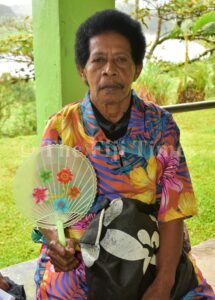
“I only knew how to cook, iron and clean. To deal with money was something I never thought I would do.”
But through coaxing and support from her elders, she volunteered to be the face of the cooperative.
“I never worked for money. I did it because it was something that would help the cooperative, support the village and uplift our lives.”
Ms Boteivanua left her job five years later when she suddenly fell ill. Today, the store is manned by mother of two, Titilia Sukanacagi.
She operates the store seven days a week, from 6am-8am, 11am-1pm and from 4.30pm to 9pm. On Sundays, the shop opens between 6am-9am and 6pm-9pm.
“I joined after finishing Form 6 at Muaniweni Collage and I like my job because I get to serve my own community,” Ms Sukanacagi said.
She said the store made $500 in sales on a slow day and $1000 during busy days and weekends.
“I am overjoyed that our cooperative store has reached 50 years and we owe its success to those who served before us and our elders who had the foresight to start it for us during the colonial days.”
Achievements and the future
There is no denying that Lovia Cooperative’s 50th anniversary is a major milestone for villagers of Gusuisavu or any other community for that matter. It is a legacy built on honest hard work.
Much of this sterling accomplishment can be attributed to the spirit of unity among members, the commitment of office bearers and the use of prudent business practices.
“Out of the 500 operating co-operatives in Fiji, the Lovia Cooperative Limited is one of most successful co-operative businesses and your journey acts as an inspiration to new and emerging co-operatives around Fiji,” chief guest and Minister for Trade, Cooperatives, Small and Medium Enterprises and Communications, Manoa Kamikamica told villagers.
“Just like Lovia Co-operative, the Coalition Government aims to replicate your success through good governance, open and honest management practices and strong leadership and I thank you all for your lasting impression for the people and community you serve.”
In the recent past, the cooperative’s contributions to development in the village has been immense, including funding the electrification of all homes in the village in 1992, purchasing of village church pews, sponsoring sports and distributing yearly bonuses and death benefits to members and their immediate families.
Lovia Cooperative members are today proud owners of a retail store, a transport business, a bakery and a petrol station.
“Without our forefathers’ vision, we wouldn’t have reached our 50th anniversary,” Mr Tuidana said.
“They entrusted the shop to us and their plea was, whatever happens, to always look after the shop and to keep in mind the hardships they faced during the banana trade and the early days.”
Looking into the future, Mr Tuidana said the village cooperative would continue to survive if its members worked together and managed money and time wisely.
He said, the business model on which all cooperatives were based on, suited the indigenous way of life and culture, and many villagers should be encouraged to form theirs. Gusuisavu’s Lovia Cooperative has 112 members.
Only two are women.

