
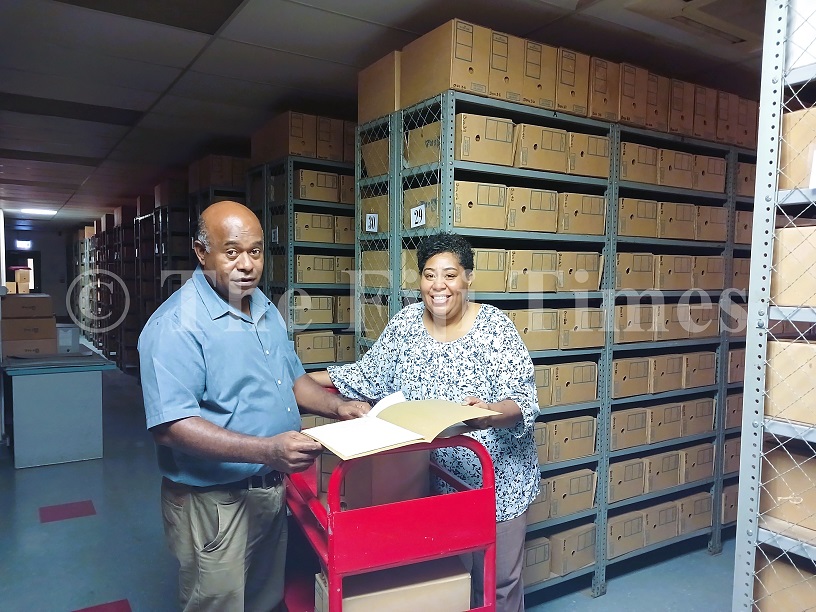
Sometimes the greatest things in life happen when we don’t expect them at all.
Such was the reality experienced by National Archives of Fiji’s principal archivist, Timoci Balenaivalu.
Timoci possesses a rare skill. He is one of a few people in Fiji qualified to do the intricate task of maintaining official files and records and that has made him the President of the Pacific Regional Branch of the International Council on Archives (PARBICA).
The Nakorosule, Naitasiri man is the youngest of three siblings.
Mr Balenaivalu schooled in a number of schools where his civil servant father was posted.
He attended Ra High School, Ba Provincial High School and Shri Vivekananda High School now known as Swami Vivekananda College.
It was after completing high school that his career in record management took shape quite unexpectedly.
With the hope of earning an income during the school holidays, Balenaivalu went on a job hunting spree.
It was during this time of job seeking that he recalled what his careers teacher once told him: “There is a huge difference between writing a letter and visiting an office when job hunting.
Balenaivali took to heart that piece of advice.
“I was actually passing the building (National Archives of Fiji) when I met someone who worked for TLTB (iTaukei Land Trust Board) who said the office (National Archives) had a vacancy.
“I didn’t even know what the archives office was, so I just walked in… asked about the work and applied.
“I started work here in 1994, at the age of 20 and just after finishing Form 7,” he said.
From those early days of temporary work, he now has clocked up almost thirty years of service and has a treasure trove of knowledge and skills in record keeping and maintenance.
He started off as a junior officer. In those days newbies were called archives assistants – class 2.
“Once I started working, I began to learn about the work and what it involved,” he said.
“I worked as a reprographer, like a microfilm officer. I had to collate old records to be put into film… it’s like digitisation.
“Before you film records, you must see that the pages follow the same order as the original document. If you have a month-old paper to be filmed, you must see that all the papers and pages are together and in the correct order.”
Mr Balenaivalu said when certain pages went missing, they had to get a copy from the required office or agency as a substitute.
“That is one way of preserving records, through microfilming.
“My interest also grew when I started to meet people who came in to do research, search for genealogical information and those looking for historical information on their tribe or land, because in the history of Fiji there is a lot of moval (transfer of one’s property or business).”
“I would meet a lot of people and I found it really interesting, listening to them and then finding records to support their stories.”
He started working at a time when the work culture was less competitive and people were always willing to impart their knowledge.
“I had a supervisor at the time who, when I walked in early in the morning, was already at work.
“He did his job very early in the morning, so I got to learn from this experience. By 10am almost 75 per cent of his tasks would be complete.”
In a quest to succeed in his field, Mr Balenaivalu followed his supervisor’s work ethics and walked in his footsteps. Over time, he became productive and efficient and climbed up the ranks.
As a junior officer he was required to do menial and outdoor tasks and the experience they brought about built his character.
Mr Balenaivalu said at one point in his career, he was tasked to take pot plants outside every Friday.
“And then on Monday morning I would bring them back into the office and place them where they should be.”
Years of handling records and documents also comes with it its own set of eerie experiences, he said.
“We have a lot of stories.
“In the older building you could hear people walking or sweeping….”
“At night, usually around 7pm the phone would ring.”
“When these happened, I would tell the staff that it was time for us to go home.”
Mr Balenaivalu also enjoyed interacting with members of the public and helping them out.
“At times they (directors/supervisors) would ask me to sit on the switchboard, so I answered calls and learned about customer service.”
“I learnt how to politely interact and help the public,” he said.
Looking back, Mr Balenaivalu believes his journey has reaped great success but only after instilling in him the values of discipline and hard work.
Despite entering a career field knowing very little about record management, Timoci has successfully established himself as an accomplished archivist.
Through a scholarship he was able to secure, Mr Balenaivalu spent 2011 and 2012 at the University of Western Australia and graduated with a Post Graduate Diploma certificate in information management specialising in archives and records management.
He believes in the importance of proper record keeping and advises all government agencies and other organisations to follow proper record keeping practices.
He said proper record keeping was an integral part of ensuring that institutions and offices were transparent, accountable and practiced good governance.

