
Last week, I wrote about the daily rhythms we have come to accept as a developing Pacific Island country, located where it can be paradise one minute, and hell on earth the next, with a catastrophic cyclone or life-threatening floods.
And as we must, we prepare for all outcomes, knowing this will determine how we emerge later. This week, we approach the national budget with that same preparation.
Having voiced the challenges faced across the sector, we now move forward with a deliberate and evidence-based list of recommendations for Government’s national budget, always focused on unlocking tourism’s full potential. The impact of spreading this potential across communities is profound, stimulating local enterprise, strengthening supply chains, and ensuring that the benefits of a higher-performing tourism industry ripple outward to create inclusive growth and sustainable livelihoods.
As reported earlier, paid employment in Fiji rose to 121,971 in 2022, up 7.1 per cent from 2021, according to the Fiji Bureau of Statistics, with the biggest growth from accommodation and food services, adding 3453 jobs or a 49 per cent increase. Arts, entertainment and recreation, along with other service activities, also recorded strong growth – all part of supply chain demands from tourism.
At its core, the message is simple. While tourism is performing well now, with demand for the Fiji product currently steady and high, this may change very quickly. As the ADB has recently warned, Fiji’s economic growth is expected to ease over the next two years as global and domestic challenges weigh on key sectors, that includes tourism. They have forecasted our economic growth to slow to 2.9 per cent in 2026 and 2.7 per cent in 2027, citing softer tourism demand, pre-election uncertainty, and weakening external conditions. This puts the government’s elusive 5 per cent annual growth out of reach for a third and even 4th year in a row.
How can we ensure we continue to support economic growth as an industry despite rising global and domestic pressures threatening progress? Consider that the domestic environment we are operating in has become more complex, more expensive, and in many areas, less efficient. If we want the industry to continue contributing at the level Fiji depends on, then the conditions around it need to keep pace. The first and most consistent issue we are raising is the ease of doing business – another elusive National Development Plan (NDP 2025 – 2029) focus that has not been able to achieve the required buy-in from the government agencies that every business in Fiji must deal with
This is not about removing regulation or even the often-unwarranted costs of licenses and fees, but simply about HOW regulation works in practice. There are still far too many repeated and fragmented processes across agencies where support is tokenistic, and service is abysmal. Approvals move in sequence instead of in coordination. Timeframes are unclear. Businesses are left navigating multiple systems for what should effectively be a single outcome – compliance.
Lost time between approvals translates directly into business delivery delays, stalled developments, and rising costs that inevitably reach consumers. Digital platforms are progress, but digitising a slow process does not make it efficient. If approvals still take months and documentation remains duplicated, the problem has not been solved; it has simply been moved online and kicked further down the road.
Measurable improvement is needed – clear service standards, real reductions in processing time, and better coordination between agencies. A system that matches the pace of investment decisions. Because when approvals drag, projects stall, costs climb, opportunities vanish, and in tourism, timing is everything.
The second issue is the implementation of the VAT Monitoring System.
We understand the objective. Compliance, transparency, accountability. These are not contested. What is contested is how the system is introduced to businesses that are not simple retail operations. A hotel does not run on a single point-of-sale device. It operates through integrated systems, reservations, property management, food and beverage, activities, and finance. Introducing a new compliance layer into that environment is not a plug-and-play exercise. It requires integration, testing, training, and ongoing maintenance. These come at a cost and require supportive policies that make it work.
We need solutions for the SMEs that want to be compliant but do not have the budget, skills or manpower for a practical rollout. We need clear technical standards, adequate lead times and phased implementations for those that need it – because there is no “one size fits all” in tourism. Thus far, we have welcomed the continued consultation with FRCS with the mutual understanding that if the system is implemented well, it will achieve its objective.
The unavoidable discussion on infrastructure is our third key area that we have no doubt the government fully understands the challenges in, but might appreciate some private sector perspectives on. We certainly hope they’re open to it anyway. After all, if we get the opportunity to contribute to and grow the economy, the government gets more revenue to pay for it all.
Water, wastewater, waste management, energy, roads and housing. Nothing new. We will leave health services to those proponents who are better at that subject matter. These are certainly not secondary issues for tourism – they are the foundation on which the industry operates. When water supply or power is inconsistent, businesses invest in their own systems – at a cost. When wastewater infrastructure is inadequate, environmental risk increases. When roads are poor, transfers are delayed, costs rise, and the visitor experience suffers. And when growth is limited by the cost and effort to transport staff in from residential areas that are two towns away, it is clear to the industry that planned affordable housing and investment support for public transport systems have failed miserably.
These concerns directly affect daily operations, driving up costs, eroding productivity, and consuming time and resources that could otherwise advance progress. Any priority given to infrastructure will directly impact tourism. Water and wastewater must be treated as essential economic infrastructure, not optional upgrades. Energy resilience must be strengthened. Road access and reliability must be improved.
These are not investments for tourism alone; they underpin community wellbeing, safeguard public health, and drive wider economic activity. When infrastructure is robust, tourism thrives, but so too do the communities and industries that depend on it.
Alongside this sits investment and the heavy price we pay for investments that walk away because we have not considered the impact of badly thought-out policies that influence how existing businesses are affected, and potential business holds back or moves away. Policies like the Employment Relations Amendment Bill have seen fit to add a whip to every breach, perceived or real, intentional or not. Or the fact the we are even considering a Waste to Energy proposal in a developing tourism corridor in light of the sustainability pathways we have agreed to in the National Sustainable Tourism Framework (NSTF), and in direct breach of the Waigani Convention, a protocol that bans the importation of such waste into Forum Island Countries and regulates its transboundary movement within the South Pacific. Or the Commercial Use of Marine Areas (CUMA) Bill – designed with what might appear to be the best intentions, but with no consultations and so poorly conceived and drafted, that it risks undermining its own purpose. Instead of enabling sustainable development, it creates uncertainty for tourism operators and landowners alike, raises legal concerns on constitutional rights, and threatens to stall investment in the very marine areas it seeks to regulate, which would create exclusivity where we have been advocating strongly for inclusivity.
Fiji’s tourism product cannot stand still. Hotels and resorts must continually upgrade, transport providers must embrace better technology, and the industry must consistently review renewable energy options to support environmental concerns and adapt to remain competitive. New developments are important, but so is maintaining what already exists. This is where targeted incentives that support reinvestment in existing assets are critical – protecting what we have already built.
Access to skills is still an issue that the industry has been forced to adapt to. While we have increased our workforce, this has come at considerable cost – in-house training programs have increased, wages have increased, and staff investments (transport, training, retention programs) have also increased. Sustained investment in training through practical, industry-aligned programmes with clear pathways for young people is still a high-priority need. This includes leadership development, specialised skills that are not always available locally, and faster approval processes for expatriate roles need to be more efficient and predictable.
We are pitching once again for national resilience. In growing more of our own food and reducing our dependence on imported produce. This requires coordination, production aligned to demand, reliable supplies, quality assurance, consistency in logistics and government-enabled cold chain infrastructure.
Energy is another area where external pressures are being felt directly. Fuel price volatility affects everything, transport, utilities, logistics, and inevitably drives costs upward. These costs cannot always be passed on to visitors without eroding competitiveness.
We are asking for support in building resilience because the policies that could enable wider adoption of renewable energy, such as solar power, are either inadequate or not in place within the very agencies responsible for approving such projects. Approvals remain slow and fragmented because off-grid operations are not understood.
What need supportive policies and genuine inter-agency collaboration to incentivise renewable energy uptake, both commercially and domestically. It should make economic and practical sense: energy-efficient systems, storage solutions, and more reliable infrastructure mean less pressure on existing grids. Without this, Fiji risks missing opportunities to reduce costs, strengthen resilience, and align with global sustainability expectations. And where global shocks create exceptional cost pressures, consideration of targeted, temporary relief measures to help businesses maintain viability. Not long-term subsidies – but preparation for cushioning extreme external impacts.
This brings us back to the point made last week. While not everything in our submission will be considered, we hope some measures will land. Some will be acknowledged. No doubt some will be ignored as they are each year.
But that does not change our approach.
Tourism is already carrying much of the weight in Fiji’s economy; it can do even more, but only if the right policies, infrastructure, and support are in place to unlock its full potential for growth, resilience, and shared prosperity.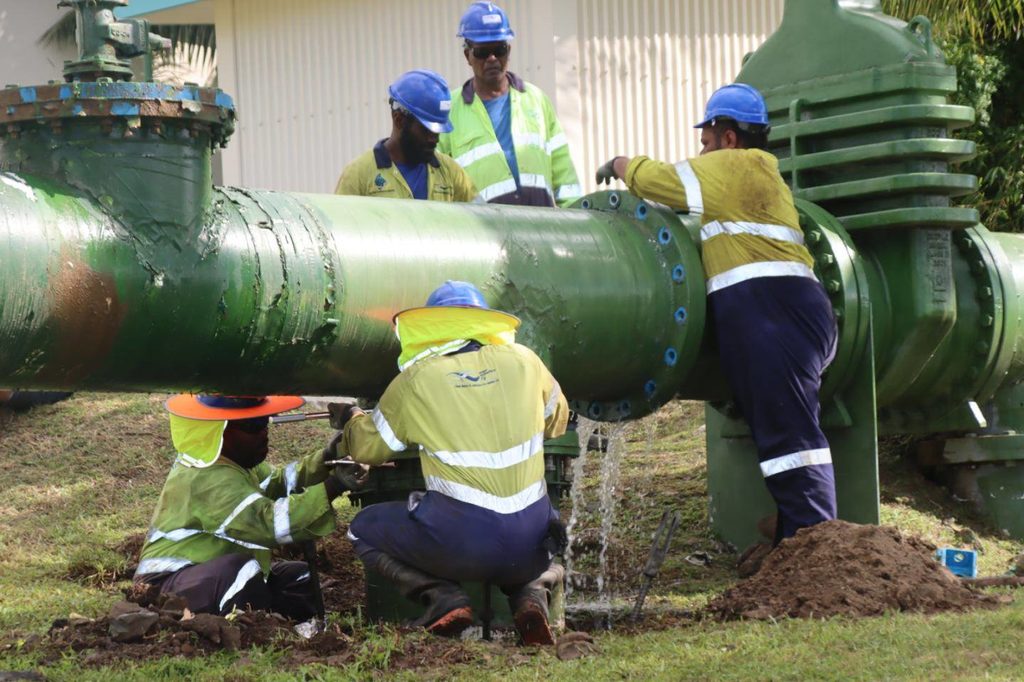
WAF engineers carry out valve replacement works in Tamavua, Suva. Picture: WAF

