
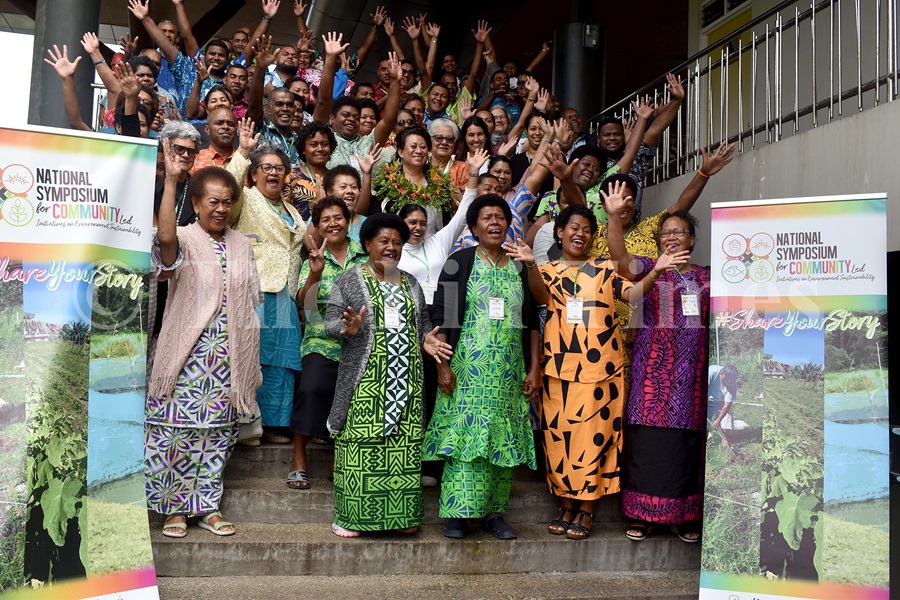
A three-day National Symposium for Community-Led Initiatives on Environment Sustainability was held at the Albert Park conference room in Suva this week. Participants shared success stories, developed a network of community practitioners for collaboration and support, and amplified community voices to influence decision-making at local and international levels. The event featured sessions on food security, clean energy and sustainable urban solutions, addressing challenges and issues that participants’ communities face.
Clean water needed for Mali villagers in Macuata
Participant Inoke Koroduadua, a schoolteacher at Mali District School for 10 years, was invited to speak on the UNDP’s small grants project on solar water pipes, which the villagers of Mali have undertaken. “One of the major issues we face is the availability of clean water,” Mr Koroduadua said. “The only main water supply in our school is rainwater. “We have water tanks installed for the rainy season because during the dry months, there’s hardly any water for the school.” The villagers don’t have an electricity supply as well. “So, we have solar,” Mr Koroduadua said. “With the help of WWF Labasa and the provincial office in filling and submitting the forms, we were able to carry out that project after it was approved.” Mr Koroduadua said the solar water pump has been of great help because it operates during the dry months.
Vaivai water borehole project
Irene Lata, of the NGO Building Innate Resilience Through Hearts (BIRTH) Fiji, said they visited Vaivai Village in Lautoka to raise community awareness of mental health and domestic violence against women and children. There she found that the villagers have no access to clean water. “Normally, we work on mental wellbeing, domestic violence and child abuse. So, we go out to the interior of Vanua Levu and Viti Levu and see how people, especially women, are doing in rural places,” Ms Lata said. “On our visit to Vaivai Village, we found out about their water situation. “For drinking and cooking water, they have to call the Water Authority of Fiji (WAF) and WAF comes and refills once a month. “If it’s rainy or the road is not good, then the water truck doesn’t deliver. “So, the water they get once a month from WAF, they save it for cooking, but bathing and everything else is done in the river.” Ms Lata said they decided to work on an initiative to help the villagers with their water needs. “We had discussions with their advisory council, but the discussions did not go well because they were tired of hearing talk but no action. “They’ve asked for support for so long, they’ve just given up.” Ms Lata said many people had visited the village but have been of no help at all. “They would leave saying they would help, but nothing so far. They’ve lost all hope. “But we didn’t let that stop us.” Initially, Ms Lata said, it took a lot of work to gain their trust. “When we wanted to gather the community, we would call out to them but nobody would show up. “When we visited their homes, no one wanted to open their house to us.” Ms Lata said their CEO, Satib Nisha Khan, wrote a proposal for funding for a borehole project for the villagers of Vaivai; there were also discussions with other stakeholders. “The project was also undertaken once the team recognised the difficulties faced by women and children in these communities after providing counselling services to those traumatized by having had miscarriages, injuries and illnesses due to the scarcity of water in the area. “We need more funding as well to fix tanks because we realised that three houses could share one water tank. “So, having had the experience of attending and participating at the symposium, I would like to share and talk about the struggles we’ve heard from those in rural areas, and gain knowledge and support and, hopefully, collaborate with other stakeholders.”
UNDP grant and collaboration with Rabi Island
Teri Kano, a representative from Rabi Island, shared with other participants how the Banabans utilised the funds. With Rabi’s success in collaborating with UNDP, receiving a grant of $US40,000 ($F88,529)to help alleviate their economic problems with programs such as the Banabans Virgin Coconut Oils, reforestation and clean-up campaigns have helped improve their living standard. “We are recipients for the Business Incubator and Accelerator (BIA) for Mountains and Islands, and we have received a grant of $40,000 which will help Rabi organics with its activities,” Mr Kano said.
“These include awareness programs, coconut rehabilitation, reforestation and clean-up campaigns, and also for Banaban Virgin Coconut Oils. It is to be used for solar energy, which we have received and which cost us about $21,000. “We are getting machines from Malaysia to speed up production on the island and other avenues which will raise profits for Banaban Virgin Coconut Oils.” Mr Kano said they were continuing to empower and train the people, especially on reviving coconut production, which needs the support of both men and women. “Because if men can do the cutting of the toddy, our women are able to do it as well. “Working together with their husbands will lighten the job as well. Women won’t have to rely on the men to cut toddy. “We want to have more women participate in organic activities like planting in order to generate income and to raise the process of their organic produce.”

