
A NEWLY launched report by the Asian Development Bank states that despite the government’s higher investments in tertiary education, some higher education institutions (HEIs) in Fiji have noted that there is still need for financing, given the growing demand for tertiary education services from within Fiji, but as well as the neighboring Pacific economies.
The Pacific Economic Monitor for July states that while the ongoing investment in education by the government may seem an encouraging trend, it also highlights some limitations to the flow of resources for other levels of education, including early childhood, primary, and secondary.
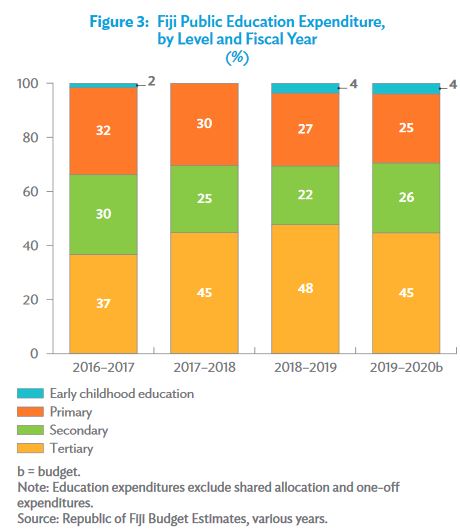
According to the report in FY2019, the government allocated 48 per cent of its education budget to tertiary education covering 15 per cent (41,946 students) of the total schooling population versus an allocation of 52 per cent that accounts for the remaining 85 per cent (273,300 secondary, primary, and early childhood education students) (Figure 3).
“However, tertiary education by convention is usually more expensive. For instance, the government could use the same amount of funds to support 2–4 students to complete early childhood and primary education versus supporting one student to complete tertiary education,” it stated.
The report stated that the quality of education must continuously be strengthened.
“The Fiji Higher Education Commission in charge of supervising and regulating tertiary institutions, has declared that all tertiary institutions must abide by the Fiji qualifications framework in order to meet student–customer’s needs.
To achieve the Fiji Higher Education Commission’s vision to build an educated and globally competitive Fiji, it is critical that the Ministry of Education and tertiary institutions—including the Fiji National University, the University of the South Pacific, the University of Fiji, and other smaller universities—work closely with the commission to ensure quality alignment of education support to build a skilled workforce.”

