
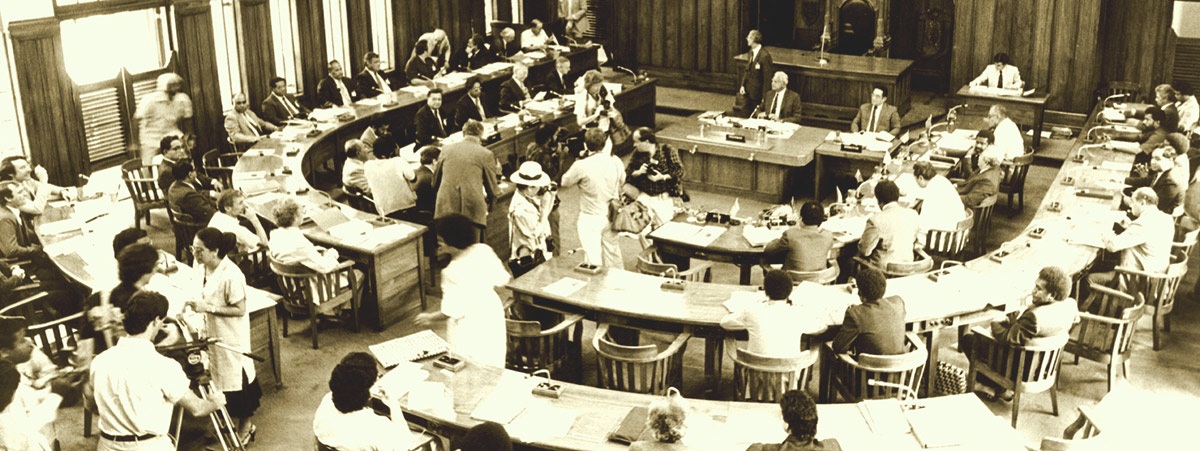
Political discourse in Fiji is and has been often dominated by questions of power, however, the life story of our first woman senator is a timeless example of a different kind of leadership.
One that resonates with the people and which many political leaders lack today. One measured by service, principle, and an unwavering commitment to the public good.
The question of whether Fiji is ready for a woman Prime Minister is still occasionally posed.
Yet, the answer has been evident since 1970, when a softly spoken, eminently feminine former teacher from the Bua Province broke a significant barrier.
She became the first woman appointed to Fiji’s newly-established Senate, setting a precedent for generations to come.
Senator Anaseini Qionibaravi is far from the stereotypical image of an aggressive political campaigner.
She was a wife and mother of four and a trailblazer in her own right who earned respect and admiration through quite determination and a profound dedication to community service.
Her journey is marked by being a pioneer in the political arena and a passionate protector of consumers’ rights.
After attaining her education at Labasa’s St Mary’s, she went on to study at the prestigious Adi Cakobau School (ACS). Her pathway to national leadership began in education.
After training at Nasinu Teachers College, she specialised in home economics on a two-year government scholarship at Auckland Teachers’ College.
This foundational experience would influence what would become her lifelong passion to educate and empower victims of unscrupulous business tactics.
Upon her return, she taught for eight years before transitioning to a role as a radio announcer at Radio Fiji, where she hosted a daily women’s program.
But her most significant contributions were yet to come.
After independence in October 1970, Prime Minister Ratu Sir Kamisese Mara appointed her as one of his nominees to the upper house.
As the only woman amongst 21 men, she was acutely aware of her symbolic role.
“One of the most satisfying realisations was that women were being recognised at this level,” she recalled in a 1976 interview with The Fiji Times.
“So, I was more or less, a spokesman on women’s affairs.”
Simultaneously, with her unique background in home economics and community service, she was tasked with another pioneering role of becoming the founding chairperson of the Consumer Council of Fiji in 1971.
In an inflation-ravaged Fiji, this was one of the most important and equally frustrating jobs in the country.
The council then was a voluntary, non-political body established to educate consumers and investigate complaints about poor quality products, fraud, and misleading advertisements.
“The government felt by educating consumers, people would be made more aware of their personal roles and thus take pressure off the government,” she explained.
Yet, the council initially had no real power.
As she told Pacific Islands Monthly in 1972, their only weapon was publicity.
Shopkeepers, she noted, would simply ignore them, and one staff member was even thrown out of a store for writing down prices.
“People say the council is doing a marvellous job but we’re not satisfied with that. There’s much more to be done,” she stated.
“The only weapon we have is publicity, but at present we can’t name the guilty offenders or take them to court. We need these powers. We need some real teeth.”
She travelled internationally, connecting with consumer organisations in Australia, the United States, and New Zealand to learn best practices.
She was a passionate advocate for introducing consumer education in schools, believing that young people should “understand their role as consumers and become responsible buyers”.
Her work had a particular focus on protecting Fiji’s most vulnerable.
She noted that the burden of vigilance was heaviest on rural people, who were transitioning from a subsistence economy to a cash-based one and had few shops to choose from.
“If I had the choice, I’d rather work in the rural areas and educate the villagers to budget and buy wisely,” she said.
Anaseini Qionibaravi’s legacy is a powerful one indeed.
Her ethos and guiding principles demonstrate that leadership is not about waving banners or aggressive grandstanding, but about diligent, principled work to improve the lives of all citizens.
In today’s Fiji, where the public’s primary demand from its leaders remains tangible results and better service delivery, her life’s work continues to stand as a benchmark for what truly matters and of course some of our current women in leadership would do well to emulate the late senator.

