
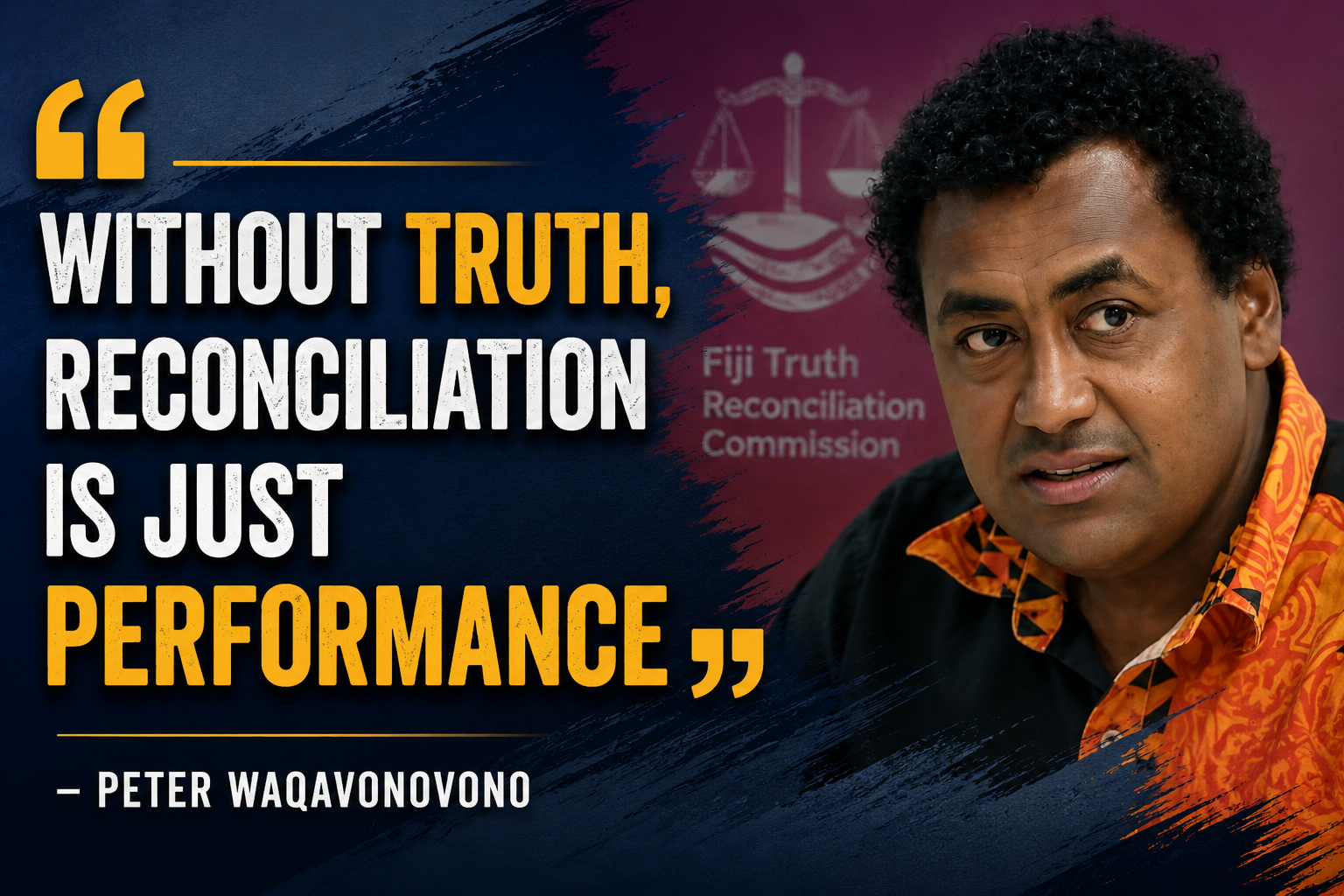
A former detainee who says he endured beatings and detention during Fiji’s political turmoil has told the Fiji Truth and Reconciliation Commission that forgiveness became his “only weapon” against a system he claims was used to silence him.
Speaking during a Commission hearing in Suva on Wednesday, Peter Waqavonovono, 42, of Tubou Village in Lakeba, Lau, recounted his experiences of alleged abuse and his eventual reconciliation with those he says harmed him.
“The media have covered my beatings, my detainments, and—perhaps more difficult for some to understand—my forgiveness of those who acted to hurt me,” he said.
“With the rules held against me, the system not in my favour, and an institution meant to protect me used instead to silence me, forgiveness and truth became my only weapons.”
Mr Waqavonovono said he later attended a traditional matanigasau reconciliation ceremony where he came face-to-face with former military officers, including Ratu Tevita Mara and Pita Driti.
“I attended that matanigasau totally embarrassed,” he said.
“In the case of Ratu Tevita Mara, I did not see him as a soldier—I saw him as my chief: the Turaga na Tui Nayau, Sau ni Vanua, and Tui Lau.”
He said the traditional act of seeking forgiveness held deep meaning within iTaukei culture but stressed it could never replace justice or legal accountability.
“In our culture as Indigenous Fijians, the act of kere veivosoti or matanigasau is central to how the iTaukei maintain social harmony and mend broken relationships,” he said.
“It is not justice. I want to be clear on that point. No traditional ceremony can replace the rule of law, nor should it be used to bypass accountability.”
Mr Waqavonovono said reconciliation without truth amounted to performance, while truth without reconciliation risked becoming bitterness.
“I offer it because truth and reconciliation are two sides of the same coin. Without truth, reconciliation is just performance.
“Without reconciliation, truth becomes only bitterness. But neither should be used to excuse impunity.”
He also questioned the long-term impact of constitutional immunity protections, saying they may shield perpetrators legally but do not free them spiritually or psychologically.
“A chief who cannot apologise ceases to be a chief,” he said.
During the hearing, Mr Waqavonovono stressed he was appearing before the Commission not out of revenge, but to ensure the truth was documented while survivors were still alive.
“I am not here for revenge. I am here because the truth must be written down while we who lived it are still alive,” he said.
“I am here because carols should never again be sung over the sound of beating.”
He added that Fiji must move beyond symbolic reconciliation and take practical steps to end torture and impunity.
“These are not academic ideas. They are born from the ground where I was kicked, and from the road where I was thrown like rubbish,” Mr Waqavonovono said.

